
Ozempic Users: This Is What's Happening to Your Testosterone
Published on:
Updated on:
People are asking...
Do you have any theories as to why some people experience a honeymoon phase for a few weeks then lose the benefits of TRT?...
The most common reason for this in men tends to be a need for a simple dose adjustment. There's a general 8 week uptake period where injected levels increase week over week & then natural production ... See Full Answer
Why would my dose response drop so dramatically? 6 moths from start treatment: 133 mg/week. EOD frequency. Test on the morning before evening injecti...
The fact that your SHBG is dropping along with your TT and FT suggests you may have a problem with your liver’s metabolism. The liver performs over 500 different tasks, and one of those is metabolism ... See Full Answer
Why would my dose response drop so dramatically? 6 moths from start treatment: 133 mg/week. EOD frequency. Test on the morning before evening injecti...
The fact that your SHBG is dropping along with your TT and FT suggests you may have a problem with your liver’s metabolism. The liver performs over 500 different tasks, and one of those is metabolism ... See Full Answer
Have a question? Ask us.
At AlphaMD, we're here to help. Feel free to ask us any question you would like about TRT, medical weightloss, ED, or other topics related to men's health. Or take a moment to browse through our past questions.
You've been using Ozempic for a few months now, the scale is finally moving in the right direction, but something feels off. Maybe your energy isn't what you expected, your libido has taken a nosedive, or you're just not feeling like yourself despite dropping the weight.
If you're a man taking GLP-1 medications like Ozempic or similar drugs, you're not alone in wondering what's happening beneath the surface. Weight loss should make you feel better, right? But when it comes to testosterone, the relationship between shedding pounds and maintaining healthy hormone levels is more complicated than most people realize.
What Ozempic Actually Does in Your Body
Before we talk hormones, it helps to understand what's happening when you inject semaglutide (the active ingredient in Ozempic). These medications belong to a class called GLP-1 receptor agonists, which mimic a hormone your gut naturally produces after eating.
The effect is straightforward but powerful. Your brain gets stronger signals that you're full, your stomach empties more slowly, and your pancreas releases insulin more efficiently. The result? You eat less without the constant battle against hunger, and your blood sugar becomes more stable.
For men carrying excess weight, especially around the midsection, this can be transformative. But your body doesn't exist in isolated compartments. When you change one major system (your metabolism and fat storage), other systems (like your hormones) respond in ways that aren't always predictable.
The Fat Cell Connection You Need to Know About
Testosterone doesn't just float around your body doing its own thing. It's constantly interacting with your fat tissue in a bidirectional relationship that most guys have never heard about.
Fat cells, particularly the visceral fat around your organs, contain an enzyme called aromatase. This enzyme converts testosterone into estrogen. When you're carrying significant excess weight, you essentially have more of this conversion happening, which can suppress your testosterone levels. It's one reason why obesity and low testosterone often go hand in hand.
When you lose weight on Ozempic, you're reducing that fat tissue and, theoretically, reducing the conversion of testosterone to estrogen. This should be good news for your T levels. Many men do see improvements in their testosterone as they lose weight and their metabolic health improves.
But that's only part of the story.
When Rapid Weight Loss Creates a Hormone Disruption
Weight loss from GLP-1 medications tends to happen faster than traditional diet and exercise approaches. While that's appealing (and often medically beneficial), rapid weight loss can trigger a stress response in your body that affects multiple hormones, including testosterone.
Your body interprets significant calorie restriction as a potential threat. From an evolutionary perspective, this makes sense. When resources are scarce, your body downregulates processes that aren't immediately essential for survival. Reproduction falls into that category, and testosterone production can take a hit as a result.
This doesn't mean Ozempic directly lowers testosterone. Rather, the dramatic calorie deficit it enables can create conditions where testosterone production decreases. It's the same mechanism that affects men who crash diet or lose weight very quickly through any method.
The catch? You're likely eating far fewer calories than you realize because the medication is so effective at suppressing appetite. Unlike someone consciously restricting calories who might feel the deprivation acutely, Ozempic users often don't feel hungry enough to eat adequate protein, healthy fats, and overall calories to support optimal hormone production.
What You Might Actually Be Feeling
Let's get specific about the symptoms men report when their testosterone drops or shifts during weight loss. Not every experience is a hormone problem, but these are the most common patterns worth paying attention to.
Libido changes are often the first thing men notice. If your sex drive has decreased significantly, it's natural to wonder about testosterone. But before jumping to conclusions, consider that your body is undergoing major metabolic changes. Your energy is being redirected toward healing insulin resistance, reducing inflammation, and adapting to a new metabolic baseline.
Fatigue is another big one. You might feel more tired than expected, especially if you're not eating enough protein or overall calories to support your activity level. Low testosterone can cause fatigue, but so can inadequate nutrition, poor sleep, and the simple fact that your body is adjusting to functioning with less stored energy.
Muscle loss concerns come up frequently. GLP-1 medications can lead to loss of lean muscle mass along with fat, particularly if you're not doing resistance training or eating sufficient protein. Testosterone plays a role in maintaining muscle, but the primary culprit here is usually inadequate protein intake combined with lack of strength training stimulus.
Recovery from workouts might feel slower. If you're active and noticing you're not bouncing back like you used to, this could be related to testosterone, but it's more likely related to your reduced calorie and nutrient intake. Your body needs fuel to repair and rebuild, and that fuel might be in short supply.
The Metabolic Improvements That Actually Help Testosterone
Despite the potential pitfalls, there's a compelling case for how Ozempic and weight loss can support healthier testosterone levels over time.
Improved insulin sensitivity is huge. When you're insulin resistant or pre-diabetic, your body's hormonal signaling gets scrambled. Men with metabolic syndrome consistently show lower testosterone levels. By improving your insulin sensitivity and blood sugar control, you're creating a better environment for testosterone production.
Reduced inflammation matters more than most people realize. Chronic low-grade inflammation, the kind that comes with obesity and metabolic disease, suppresses the signals that tell your testes to produce testosterone. As you lose weight and your inflammatory markers improve, this suppression can lift.
Better sleep quality often follows weight loss, particularly for men who had sleep apnea or poor sleep due to excess weight. Since testosterone is primarily produced during deep sleep, improving your sleep architecture can have a direct positive effect on your hormone levels.
The key is understanding that these benefits typically emerge after the initial rapid weight loss phase, once your body stabilizes at a healthier weight and your metabolism recalibrates.
Making Sure You're Not Making Things Worse
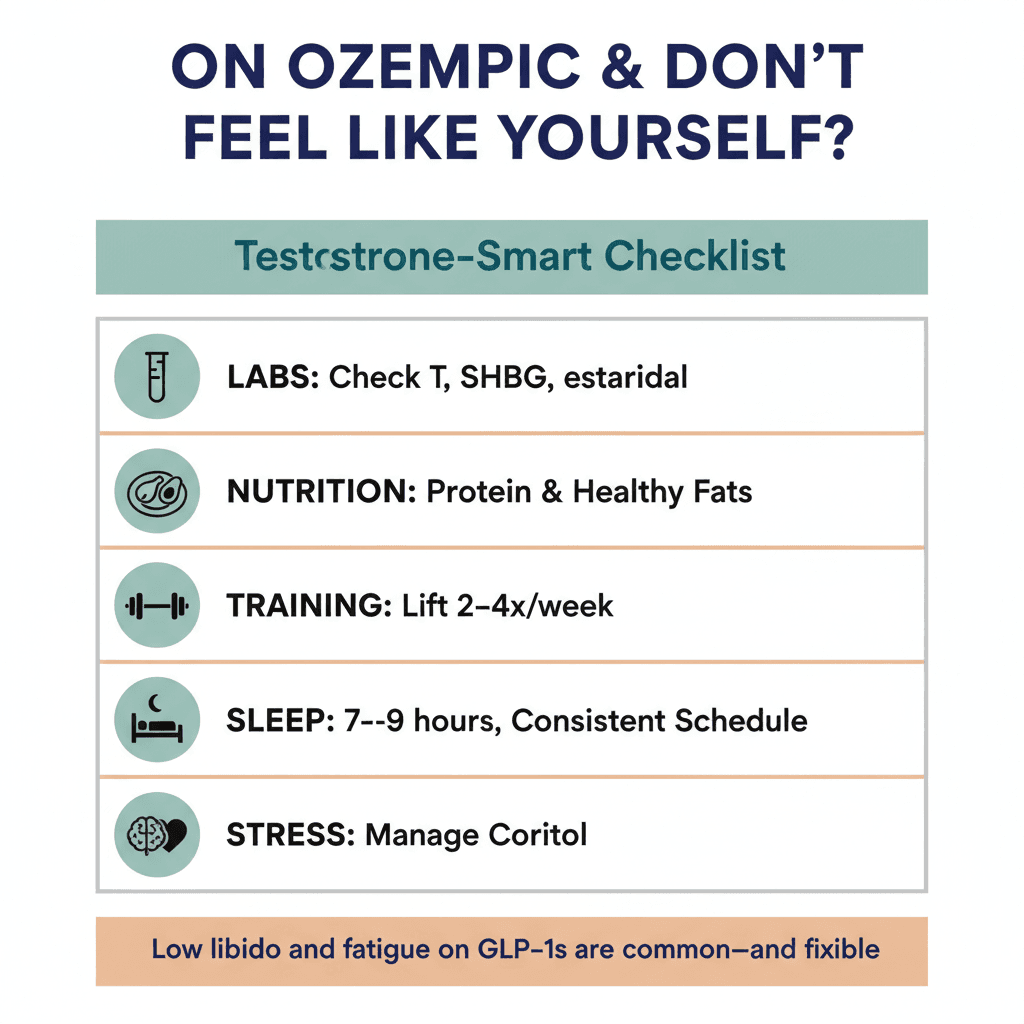
If you want to use Ozempic while protecting your testosterone levels, nutrition becomes critical. You might not feel hungry, but your hormone-producing tissues still need raw materials.
Protein intake deserves your full attention. Your body needs amino acids to produce hormones, maintain muscle mass, and function optimally. Just because you can get by on very little food doesn't mean you should. Prioritizing protein at every meal, even when you're not particularly hungry, helps preserve lean tissue and supports hormone production.
Healthy fats aren't optional. Testosterone is synthesized from cholesterol, and your body needs dietary fats to maintain hormone production. Men who drastically cut fat intake while on GLP-1 medications may inadvertently create a hormone production bottleneck.
Resistance training sends crucial signals to your body that muscle mass is necessary and should be preserved. It also naturally supports testosterone production. If you're losing weight without any strength training, you're missing a critical piece of the puzzle.
Stress management and sleep quality can't be overlooked. These lifestyle factors affect cortisol, which has an inverse relationship with testosterone. High stress and poor sleep will suppress your T levels regardless of what medication you're taking.
When Your Symptoms Deserve Professional Attention
Not every off feeling during weight loss is a testosterone problem, and not every testosterone dip requires medical intervention. But certain patterns warrant a conversation with someone who understands men's hormones.
Persistent low libido that doesn't improve as you settle into your new weight deserves evaluation. The same goes for ongoing fatigue that isn't explained by your activity level and nutrition. Mood changes, particularly increased irritability or depression, can relate to hormones but also to many other factors.
The challenge is that symptoms alone don't tell the whole story. You need actual lab work to understand what's happening with your testosterone, and you need someone who can interpret those results in the context of your specific situation (your age, your symptoms, your weight loss timeline, and your goals).
This is where specialized men's health services become valuable. AlphaMD, for instance, focuses specifically on men's health and testosterone optimization, offering comprehensive assessment that includes symptom evaluation, lab work, and individualized treatment strategies. Whether you need testosterone replacement therapy or other interventions to support your hormone health during weight loss, working with clinicians who understand the nuances of men's hormones can make a significant difference in how you feel.
Understanding the Timeline of Hormone Changes
Expectations matter. Your testosterone levels won't necessarily improve immediately when you start losing weight on Ozempic. In fact, they might temporarily decrease during the rapid weight loss phase.
For many men, the hormone picture becomes clearer several months after weight loss stabilizes. Once your body isn't in an aggressive calorie deficit, once your fat mass has decreased significantly, and once your metabolic health has improved, that's when you're more likely to see the positive effects on testosterone.
If you've been on Ozempic for a relatively short time and you're noticing symptoms, it's worth giving your body time to adjust before assuming you have a permanent testosterone problem. But it's also worth optimizing all the lifestyle factors we've discussed and getting baseline lab work so you have objective data.
Some men discover they had low testosterone before starting weight loss medication, and the weight loss just made existing symptoms more noticeable. Others find that their testosterone was actually being suppressed by their excess weight, and it improves once they reach a healthier body composition. And yes, some men need additional support through testosterone therapy or other interventions.
The point is that your individual response matters more than general statistics or population averages. Your hormone health is specific to you, your biology, your lifestyle, and your goals.
Making Smarter Decisions About Your Health
Using Ozempic or similar medications for weight loss isn't inherently good or bad for your testosterone. It's a tool that creates conditions for significant metabolic improvement, but like any powerful intervention, it requires awareness of how your whole system responds.
Paying attention to how you feel, supporting your body with adequate nutrition despite reduced appetite, maintaining strength training, and getting proper lab work all position you to benefit from weight loss without sacrificing your hormone health in the process.
Weight loss should ultimately make you feel better, more energetic, and more capable. If that's not happening, you don't have to guess about what's going on or try to diagnose yourself based on internet research. Understanding the connection between GLP-1 medications, weight loss, and testosterone gives you the knowledge to ask better questions and seek appropriate support when you need it.
Your health isn't a choice between losing weight and maintaining testosterone. With the right approach and the right guidance, you can optimize both. The men who do this best are the ones who stay curious about what's happening in their bodies, track their symptoms and progress, and work with qualified clinicians who can help them navigate the nuances of hormone health while achieving their weight loss goals.
Have a question? Ask us.
At AlphaMD, we're here to help. Feel free to ask us any question you would like about TRT, medical weightloss, ED, or other topics related to men's health. Or take a moment to browse through our past questions.
People are asking...
Do you have any theories as to why some people experience a honeymoon phase for a few weeks then lose the benefits of TRT?...
The most common reason for this in men tends to be a need for a simple dose adjustment. There's a general 8 week uptake period where injected levels increase week over week & then natural production ... See Full Answer
Why would my dose response drop so dramatically? 6 moths from start treatment: 133 mg/week. EOD frequency. Test on the morning before evening injecti...
The fact that your SHBG is dropping along with your TT and FT suggests you may have a problem with your liver’s metabolism. The liver performs over 500 different tasks, and one of those is metabolism ... See Full Answer
Why would my dose response drop so dramatically? 6 moths from start treatment: 133 mg/week. EOD frequency. Test on the morning before evening injecti...
The fact that your SHBG is dropping along with your TT and FT suggests you may have a problem with your liver’s metabolism. The liver performs over 500 different tasks, and one of those is metabolism ... See Full Answer
Get $30 off your first month’s order
Enter your email address now to receive $30 off your first month’s cost, other discounts, and additional information about TRT.
Legal Disclaimer
This website is a repository of publicly available information and is not intended to form a physician-patient relationship with any individual. The content of this website is for informational purposes only. The information presented on this website is not intended to take the place of your personal physician's advice and is not intended to diagnose, treat, cure, or prevent any disease. Discuss this information with your own physician or healthcare provider to determine what is right for you. All information is intended for your general knowledge only and is not a substitute for medical advice or treatment for specific medical conditions. The information contained herein is presented in summary form only and intended to provide broad consumer understanding and knowledge. The information should not be considered complete and should not be used in place of a visit, phone or telemedicine call, consultation or advice of your physician or other healthcare provider. Only a qualified physician in your state can determine if you qualify for and should undertake treatment.