
Important Notice
Effective August 9, 2025, only customers with an active TRT subscription will be eligible to purchase ancillary medications from AlphaMD.
Human Chorionic Gonadotropin HCG Treatment for Men
Maintain Fertility, Support Testicular Function, and Optimize
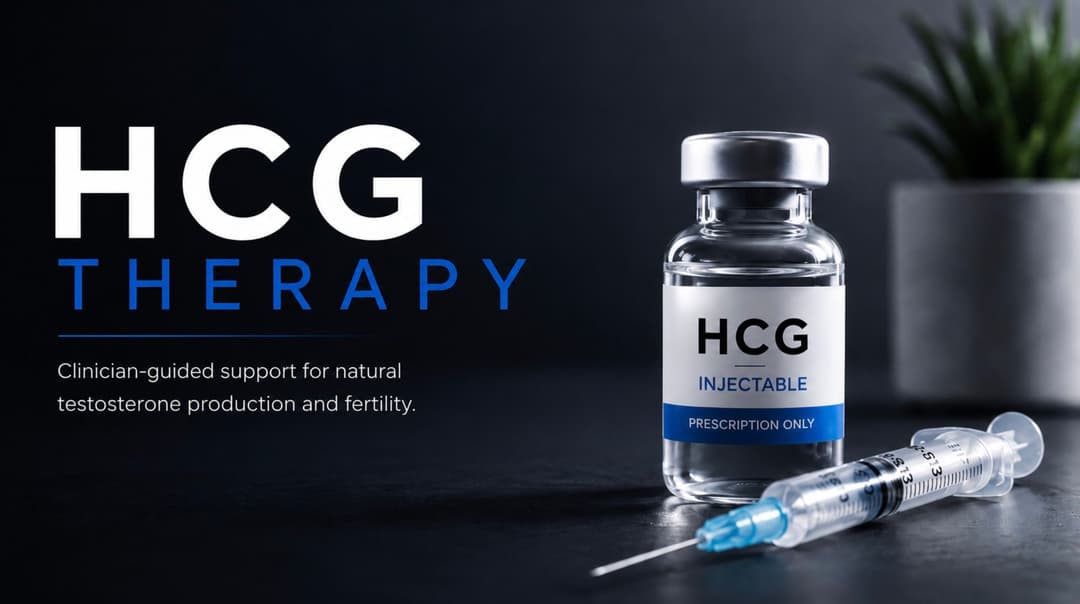
Human Chorionic Gonadotropin, commonly called HCG or hCG, is a hormone used in men’s hormone care to help support testicular function, fertility, and natural testosterone production.
For men on testosterone replacement therapy, HCG is most often used as an add-on treatment to help counteract some of the fertility and testicular changes that can happen when the body’s own testosterone production is suppressed.
TRT can be highly effective for men with clinically low testosterone, but testosterone therapy can also reduce luteinizing hormone, or LH. LH is the signal that tells the testes to produce testosterone and supports normal testicular activity. When LH drops, sperm production may decline, testicular volume can decrease, and natural testosterone production may slow down.
HCG helps by mimicking the action of LH. Instead of replacing testosterone directly, HCG stimulates the testes to keep working.
For men who want to improve testosterone levels while protecting fertility and testicular function, HCG may be an important part of the treatment conversation.
What Is HCG?
HCG stands for Human Chorionic Gonadotropin. Although it is often discussed in pregnancy and fertility medicine, HCG also has important uses in men’s hormonal health.
In men, HCG can stimulate Leydig cells in the testes, which are responsible for producing testosterone. This makes HCG useful in certain cases where the goal is to support:
- Testicular function
- Natural testosterone production
- Fertility preservation
- Intratesticular testosterone
- A more complete TRT protocol
HCG is not the same as testosterone.
Testosterone replacement therapy raises testosterone by supplying testosterone from outside the body. HCG works upstream by signaling the testes to produce testosterone internally.
That difference matters, especially for men who care about fertility, testicular size, or maintaining natural testicular activity during treatment.
How HCG Works for Men
HCG works because it acts similarly to luteinizing hormone. LH is normally produced by the pituitary gland and sent to the testes. Once there, LH tells the testes to produce testosterone.
When a man starts TRT, the body often senses that testosterone levels are already sufficient. As a result, the brain may reduce its signal to the testes. LH and follicle-stimulating hormone, or FSH, can decline. Over time, this can reduce sperm production and testicular activity.
HCG helps replace part of that signaling pathway.
In practical terms, HCG may help:
- Maintain testicular function during TRT
- Support sperm production and fertility goals
- Reduce or prevent testicular shrinkage in some men
- Support intratesticular testosterone production
- Improve hormonal balance in select TRT protocols
- Help men who are not ready for testosterone-only therapy
HCG should be used under medical supervision with appropriate lab monitoring, especially when it is combined with testosterone therapy.
HCG and TRT: Why Men Use Them Together
Many men first learn about HCG after starting TRT.
That is because TRT can improve low testosterone symptoms, but it does not preserve fertility by default. In fact, testosterone therapy alone can suppress sperm production. For men who want children now or in the future, this is one of the most important TRT conversations to have before starting treatment.
The American Urological Association and American Society for Reproductive Medicine male infertility guideline states that testosterone monotherapy should not be prescribed to men interested in current or future fertility. The Endocrine Society testosterone therapy guideline also recommends against starting testosterone therapy in men who are planning fertility in the near term.
This does not mean men with fertility goals can never receive hormone treatment. It means the treatment plan needs to be built differently.
For many men, HCG is used alongside TRT to help support fertility and testicular function while testosterone levels are being optimized.
Benefits of HCG for Men on TRT
1. HCG May Help Preserve Fertility
One of the most common reasons men use HCG is to help preserve fertility while on TRT.
Testosterone therapy can reduce sperm production by suppressing the hormonal signals that drive sperm development. HCG can help stimulate the testes and may support the internal environment needed for sperm production.
For men actively trying to conceive, additional testing and fertility-focused care may be needed. This can include:
- Semen analysis
- Hormone labs
- Review of LH and FSH
- Fertility timeline discussion
- A treatment strategy designed around reproductive goals
If fertility is important to you, it is worth understanding how testosterone affects male fertility before starting or changing treatment.
2. HCG May Help Maintain Testicular Size
Some men notice testicular shrinkage after starting TRT. This happens because the testes are no longer being signaled as strongly to produce testosterone.
HCG can help stimulate testicular activity, which may reduce or prevent testicular atrophy in some men.
This is not just a cosmetic concern. Testicular volume can be a sign of how active the testes are. For men who want to preserve function, HCG may be an important part of the discussion.
3. HCG Supports Intratesticular Testosterone
TRT raises testosterone in the bloodstream, but it can reduce testosterone production inside the testes. Intratesticular testosterone is important for sperm production and normal testicular function.
HCG can help maintain intratesticular testosterone by continuing to stimulate the testes even while a man is receiving testosterone therapy.
4. HCG May Help Some Men Feel More Balanced on TRT
Some men report that they feel better when HCG is added to their TRT protocol. This may be related to improved testicular activity, hormonal balance, or individual response.
Not every man needs HCG, and not every man feels a noticeable difference from it. But for the right patient, HCG can be a useful tool for making a TRT plan more complete.
For a deeper look at when it may or may not be necessary, read more about whether HCG is necessary on TRT.
5. HCG Can Be Used as an Alternative Strategy in Select Men
In some cases, HCG may be considered before or instead of TRT, particularly when fertility preservation is a priority.
HCG monotherapy is not the right fit for every man with low testosterone symptoms. It tends to be most relevant for men whose testes can still respond to hormonal signaling.
A clinician may evaluate:
- Total testosterone
- Free testosterone
- LH
- FSH
- Estradiol
- SHBG
- Symptoms
- Fertility goals
- Medical history
- Prior TRT use
The goal is to choose the treatment strategy that best matches the patient’s labs, symptoms, and future plans.
HCG vs TRT: What Is the Difference?
HCG and TRT are both used in men’s hormone care, but they work very differently.
TRT supplies testosterone directly. It is often used when a man has clinically low testosterone and symptoms such as:
- Low energy
- Low libido
- Poor recovery
- Mood changes
- Reduced muscle mass
- Brain fog
- Difficulty maintaining strength or motivation
HCG stimulates the testes to produce testosterone. It is often used when the goal is to preserve fertility, maintain testicular function, or support natural testosterone production.
TRT is usually more direct and predictable for raising testosterone levels. HCG may be more appropriate when fertility or testicular preservation is a major goal.
Some men use TRT and HCG together. Others may use HCG without TRT. The right approach depends on lab results, symptoms, goals, and whether fertility is a concern.
Who Is a Good Candidate for HCG?
HCG may be worth discussing if you:
- Are on TRT and want to preserve fertility
- Plan to have children in the future
- Have noticed testicular shrinkage on TRT
- Want to maintain testicular function during testosterone therapy
- Have low testosterone but are not ready for testosterone-only treatment
- Want a more fertility-conscious hormone optimization plan
- Have been told that TRT may affect sperm production
- Want to understand your options before starting testosterone therapy
HCG may not be necessary for every man on TRT. Some men are not concerned about fertility or testicular volume and may do well on testosterone therapy alone. Others may benefit from adding HCG from the beginning.
The decision should be individualized.
HCG and Male Fertility
Fertility is one of the biggest reasons HCG matters in men’s hormone therapy.
Testosterone therapy can significantly reduce sperm production. Some men assume that because TRT improves libido, it must also improve fertility. That is not always true. Libido and fertility are separate issues.
A man can feel better on TRT while producing fewer sperm.
That is why men who want children now or later should talk about fertility before starting testosterone therapy. Depending on the situation, a clinician may recommend:
- HCG
- Semen analysis
- Fertility labs
- Sperm banking
- Clomid or enclomiphene
- A different treatment strategy
- Referral to a fertility specialist when appropriate
HCG can be an important part of protecting future options.
Does HCG Increase Testosterone?
Yes, HCG can increase testosterone in men whose testes are still capable of responding to stimulation.
Because HCG mimics LH, it can tell the testes to produce more testosterone. The degree of response varies. Some men respond strongly, while others may have a limited response depending on age, baseline testicular function, medical history, and the cause of low testosterone.
This is why lab testing matters. HCG is not simply a “testosterone booster.” It is a prescription hormone treatment that should be monitored.
Does HCG Prevent Testicular Shrinkage on TRT?
HCG may help reduce or prevent testicular shrinkage in some men on TRT by continuing to stimulate the testes.
When TRT suppresses LH, the testes receive less signal to remain active. HCG helps replace some of that signal. This may help preserve testicular size and function.
Results vary, and dosing should be personalized. Men who are already experiencing testicular atrophy may need a different approach than men starting HCG preventively.
Is HCG the Same as Clomid or Enclomiphene?
No. HCG, Clomid, and enclomiphene are different medications.
HCG acts directly on the testes by mimicking LH.
Clomid and enclomiphene work higher up in the hormonal pathway by influencing the brain’s signaling system, which may increase LH and FSH production.
All three may be used in male hormone and fertility care, but they are not interchangeable. The best option depends on your labs, symptoms, fertility goals, and treatment history.
Is HCG Used for Weight Loss?
HCG should not be used as a weight-loss shortcut.
The FDA warns consumers to avoid HCG weight-loss products, especially over-the-counter drops, sprays, and pellets marketed for dieting. HCG is not approved as a weight-loss product, and the so-called HCG diet is not a safe or evidence-based approach to fat loss.
At AlphaMD, HCG is discussed in the context of men’s hormone health, fertility, testicular function, and TRT support, not crash dieting.
How HCG Treatment Works
A medically guided HCG plan usually begins with a review of symptoms, health history, goals, and lab work.
Important factors may include:
- Total testosterone
- Free testosterone
- LH
- FSH
- Estradiol
- SHBG
- CBC and general health markers
- Fertility goals
- Semen analysis when appropriate
- Current or prior TRT use
- Whether testicular shrinkage is present
- Current medications and medical history
From there, a clinician can determine whether HCG makes sense, whether it should be used alone or with TRT, and how it should be monitored over time.
HCG Dosage for Men
HCG dosing varies based on the goal of treatment.
A man using HCG to maintain testicular function while on TRT may need a different protocol than a man actively trying to improve fertility. A man using HCG as monotherapy may need a different plan than a man using HCG as an add-on.
Because HCG can affect testosterone and estradiol levels, dosing should be individualized and monitored through follow-up labs and symptom review.
Do not copy another person’s HCG protocol. The right dose depends on your body, labs, response, and goals.
For more information, read about HCG injection dosage and why dosing should be based on the specific purpose of treatment.
Possible Side Effects of HCG
HCG is generally well tolerated when prescribed and monitored appropriately, but side effects can occur.
Possible side effects may include:
- Acne or oily skin
- Mood changes
- Water retention
- Breast tenderness or nipple sensitivity
- Increased estradiol
- Headaches
- Injection-site irritation
- Changes in libido
- Worsening of hormone-related symptoms if dosing is too high
Because HCG can stimulate testosterone production, it may also increase estrogen conversion in some men. This is one reason follow-up labs are important.
HCG for Men: What to Expect
HCG is not usually an overnight fix. Response depends on why you are using it.
Some men use HCG to maintain fertility and testicular size while on TRT. Others use it as part of a fertility-focused protocol. Some use it to support natural testosterone production.
You may notice changes in:
- Testicular fullness
- Libido
- Mood
- Energy
- Hormonal balance
- Sense of well-being
However, fertility-related outcomes usually require more time and objective testing, such as semen analysis.
The goal is not just to “add HCG.” The goal is to build a hormone plan that matches your real priorities.
HCG and TRT: A Smarter Conversation Before You Start
Many men start TRT without being told how testosterone therapy can affect fertility. That can lead to frustration later, especially for men who want children in the future.
HCG gives clinicians another option. It can help build a more complete TRT protocol for men who want the benefits of testosterone optimization without ignoring testicular function or fertility.
If fertility matters to you, bring it up before starting TRT.
If you are already on TRT and noticing testicular shrinkage, changes in fertility, or concerns about long-term function, HCG may be worth discussing.
Frequently Asked Questions About HCG for Men
What is HCG used for in men?
HCG is used in men to stimulate the testes, support testosterone production, help preserve fertility, and maintain testicular function. It is commonly discussed as an add-on to TRT for men who want to protect fertility or reduce testicular shrinkage.
Why do men take HCG with TRT?
Men take HCG with TRT because testosterone therapy can suppress LH and FSH, which may reduce sperm production and testicular activity. HCG mimics LH and can help keep the testes active during TRT.
Can HCG help with fertility on TRT?
HCG may help support fertility in men on TRT by stimulating the testes and helping maintain the hormonal environment needed for sperm production. Men actively trying to conceive may also need semen analysis and fertility-focused monitoring.
Does HCG raise testosterone?
Yes, HCG can raise testosterone in men whose testes can respond to stimulation. It works by mimicking LH, which signals the testes to produce testosterone.
Is HCG better than TRT?
HCG is not necessarily better than TRT. It works differently. TRT is more direct for replacing testosterone. HCG is often more relevant for men who want to preserve fertility or testicular function. Some men use both together.
Can HCG be used without TRT?
Yes, HCG may be used without TRT in select men, especially when fertility preservation is a priority. Whether it is appropriate depends on lab results, symptoms, and the cause of low testosterone.
Does HCG prevent testicular shrinkage?
HCG may help reduce or prevent testicular shrinkage in some men on TRT by continuing to stimulate the testes.
Is HCG safe for weight loss?
HCG should not be used for weight loss. The FDA warns against HCG weight-loss products, and HCG is not approved as a weight-loss treatment.
Do all men on TRT need HCG?
No. Not every man on TRT needs HCG. It is most relevant for men who care about fertility, testicular size, or maintaining testicular function.
How do I know if I need HCG?
The best way to know is to review your symptoms, labs, fertility goals, and TRT plan with a licensed clinician. Men who want children now or in the future should discuss HCG before starting testosterone therapy.
Start a More Complete Hormone Optimization Plan
HCG can be an important part of men’s hormone care, especially for men who want to preserve fertility, maintain testicular function, or build a more complete TRT protocol.
Whether you are already on TRT or exploring treatment for low testosterone, your plan should reflect more than just a number on a lab report. It should reflect your goals, your symptoms, and your future.
AlphaMD makes it easy for men to access personalized hormone treatment plans with convenient online care, lab review, and ongoing support.
Start your consultation today and find out whether HCG belongs in your treatment plan.
Pricing
$300 /per 10,000 IU*
*This price is typical. The supply duration can be variable based on dosing schedule. Typically last 6-20 weeks.
Dosage
For Hormonal Support on TRT
- Starting Dose: 500 to 1,000 IU injected subcutaneously 2-3 times per week
- Maintenance: Adjusted based on response, as determined by your healthcare provider
This helps maintain testicular function and supports natural testosterone production while on TRT.
For Fertility Support While on TRT
- Dosage Range: 1,000 to 2,000 IU 2-3 times per week
- Purpose: Stimulates sperm production and supports fertility in men undergoing TRT
If fertility is a priority, hCG is often combined with Clomid or FSH (follicle-stimulating hormone) to optimize sperm production.
For Medically Supervised Weight Management
- Dosage Range: 125 to 250 IU daily
- Purpose: Sometimes used in weight-loss programs to assist in fat metabolism and muscle preservation
hCG for weight loss should always be used under medical supervision, as its effectiveness remains debated in clinical research.
Important Considerations
- Always follow the dosage and schedule prescribed by your provider.
- Regular monitoring is crucial to assess hormone levels and adjust treatment as needed.
- If you experience side effects or changes, consult your healthcare provider immediately.
Using hCG alongside TRT can help optimize your hormonal health, maintain fertility, and improve overall well-being. Always work with a knowledgeable provider to tailor the protocol to your specific needs.
Side Effects
While hCG is generally safe when used correctly, some men may experience mild side effects. These can include:
- Headaches
- Fatigue
- Irritability or mood swings
- Swelling or tenderness at the injection site
- Increased estrogen-related symptoms (such as mild water retention or sensitivity in the chest area)
Rare but Serious Reactions
In rare cases, some individuals may experience allergic reactions, including:
- Skin rashes
- Difficulty breathing
If you notice any severe side effects, it's critical to consult your healthcare provider immediately. Regular monitoring and adjusting your dosage as needed can help minimize potential risks.
By using hCG under medical supervision, men on TRT can safely maintain testicular function, optimize hormone balance, and support fertility with minimal side effects.
*This price is typical. The supply duration can be variable based on dosing schedule. Typically last 6-20 weeks.
Benefits
- Maintains Natural Testosterone Production
- Preserves Fertility
- Prevents Testicular Shrinkage
- Supports Libido & Sexual Function
- Balances Estrogen Levels
- Enhances Mood & Well-Being
- Supports Natural Hormonal Regulation
- May Improve Semen Volume & Quality
- Helps with Post-TRT Recovery
People are asking...
Many people are talking about using hcg instead of clomid, but hgc is simply an analogue of LH. when it comes to fertility explicitly you need both go...
You are right in that Clomid provides better fertility than hCG because it also increases FSH, which we now know matters less for sperm count, and more for sperm quality (motility and morphology). New... See Full Answer
Can you give an example of where HCG monotherapy would be suitable and the dosing strength and frequency?...
The most important aspect of choosing whether hCG monotherapy is appropriate is first determining if you have primary or secondary hypogonadism. Primary (testicular failure) hypogonadism responds only... See Full Answer
Hello I’m a 32 year old male with a history of anabolic steroid use at age 27. I’ve been having all the hallmark signs of hypogonadism Just had some r...
For you the answer would probably: Both are just fine. It more depends on your goals & what Sx you're feeling. First, it's good to find a provider to is chill with previous UGL use & can advise on wha... See Full Answer
Related Articles


Legal Disclaimer
This website is a repository of publicly available information and is not intended to form a physician-patient relationship with any individual. The content of this website is for informational purposes only. The information presented on this website is not intended to take the place of your personal physician's advice and is not intended to diagnose, treat, cure, or prevent any disease. Discuss this information with your own physician or healthcare provider to determine what is right for you. All information is intended for your general knowledge only and is not a substitute for medical advice or treatment for specific medical conditions. The information contained herein is presented in summary form only and intended to provide broad consumer understanding and knowledge. The information should not be considered complete and should not be used in place of a visit, phone or telemedicine call, consultation or advice of your physician or other healthcare provider. Only a qualified physician in your state can determine if you qualify for and should undertake treatment.