
HCG Every Day vs. Twice Weekly: The Fertility Data That Surprised Researchers
Published on:
Updated on:
People are asking...
How often do you see HCG doing nothing to preserve fertility? I had to completely quit all TRT for 6+ months to regain my fertility. I was on 250iu t...
Very rarely. Many times, we have men who didn't do a semenalysis prior to starting TRT, so we cannot always be sure they were not already infertile prior to starting therapy. So without a baseline, it... See Full Answer
Any downside to micro dosing HCG? I take 60 units per week, 17 units EOD. I have heard it is not as effective at low doses. True? Would I be better of...
I wouldn't say there's a downside to micro dosing vs more spread out injections on paper. The trouble is that when you're working with those very very small units a lot more of it tends to get lost in... See Full Answer
What dose of hcg would you recommend when starting TRT?...
The dose would depend on the purpose & a bit on financial reach. If you're going to be taking HCG for active fertility (trying to have a baby *right now* or in the next 6 months), you would almost alw... See Full Answer
Have a question? Ask us.
At AlphaMD, we're here to help. Feel free to ask us any question you would like about TRT, medical weightloss, ED, or other topics related to men's health. Or take a moment to browse through our past questions.
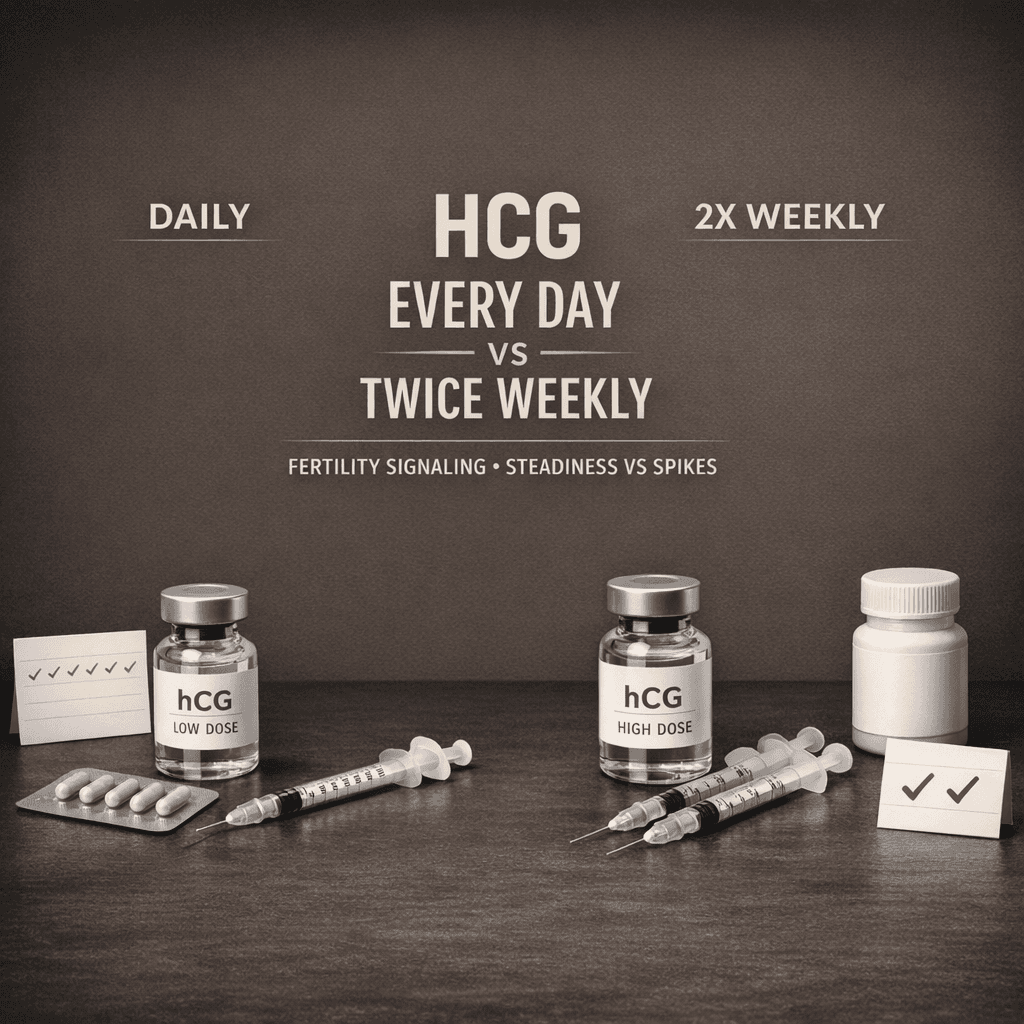
Most men on testosterone replacement therapy assume fertility is a binary problem: you're either protecting it or you're not. What the research on hCG dosing frequency reveals is that how you protect it may matter just as much as whether you do.
What hCG Actually Does in the Male Body
Human chorionic gonadotropin, better known as hCG, is a hormone that mimics luteinizing hormone, or LH. In a normally functioning male reproductive system, LH travels from the pituitary gland down to the testes and tells specialized cells called Leydig cells to produce testosterone locally. That locally produced testosterone - sometimes called intratesticular testosterone - is distinct from what circulates in the bloodstream, and it exists at concentrations far higher than anything measured in a standard blood panel.
This matters enormously for fertility. Sperm production, or spermatogenesis, depends on that concentrated local testosterone environment inside the testes. It is not driven by circulating testosterone levels in the same way. This is exactly why men who start TRT often experience a decline in sperm production: exogenous testosterone suppresses the brain's signals to the testes, LH drops, intratesticular testosterone falls, and the machinery of sperm production slows or stops.
HCG essentially steps in as a substitute signal. It binds to the same receptors that LH would, keeps the Leydig cells active, and helps maintain the intratesticular testosterone environment that spermatogenesis requires. It also helps preserve testicular volume, which tends to shrink on TRT without some form of gonadal stimulation.
The Assumption Researchers Carried Into Early Studies
For years, the dominant clinical assumption was relatively straightforward: if a man needed hCG alongside TRT, the goal was to deliver enough of the hormone to keep testicular function ticking along. The prevailing approach leaned toward less frequent, larger doses - a couple of injections per week rather than daily administration. This was practical. It reduced injection burden, fit neatly into existing TRT injection schedules, and seemed sufficient based on the half-life of the compound.
The logic was intuitive. HCG has a longer half-life than natural LH, so it does not need to be replaced as urgently. Give a meaningful dose a couple of times per week, maintain adequate stimulation, and the system should respond. Most early protocols were built around this framework, and for many men, it worked reasonably well for the goal of simply maintaining some testicular function.
What researchers did not fully anticipate was that the pattern of receptor stimulation might carry its own biological consequences - ones that showed up not just in hormone levels, but in the semen analysis data that followed.
Where the Fertility Data Got Complicated
When researchers and clinicians began looking more carefully at semen parameters in men using hCG at different frequencies, some findings did not align with the simpler assumptions. The parameters in question - sperm concentration, motility (how well sperm move), morphology (the shape and structure of sperm), and total motile count, which combines several of these factors into a single practical metric - showed variability that seemed to correlate with dosing patterns in ways that were not entirely predicted.
The surprise was not that daily dosing was always superior or that less frequent dosing was always inferior. It was more nuanced than that. Some data suggested that steadier, more continuous receptor stimulation - the kind that daily or near-daily administration produces - may support more consistent spermatogenic signaling. The LH receptor on Leydig cells appears to respond differently to a steady, lower-level signal compared to periodic larger pulses followed by relative troughs.
Receptor desensitization is part of this story. There is evidence that LH receptors can become temporarily less responsive when exposed to large hormonal surges. If that principle extends meaningfully to exogenous hCG stimulation, then the peaks-and-troughs pattern of less frequent dosing may be doing something more complex than simply maintaining steady stimulation - it may be periodically overwhelming and then underwhelming the very receptors it needs to activate.
That said, researchers were careful to note that the picture is not clean. Not every study showed the same pattern. Population differences, baseline fertility status, duration of TRT use before adding hCG, and individual receptor sensitivity all create noise in the data. The findings were interesting enough to shift clinical conversations, but not definitive enough to declare one protocol universally superior.
Why Semen Parameters Are Not the Whole Story
It is tempting to treat semen analysis numbers as the finish line in any fertility discussion. They are measurable, relatively objective, and provide something concrete to track. But semen parameters are intermediate markers. The actual endpoint that matters to most men and their partners is pregnancy - and the relationship between semen parameters and natural conception rates is probabilistic, not deterministic.
A man with modestly reduced sperm concentration may still father a child with no difficulty. Another man with technically normal parameters on paper may face unexplained fertility challenges. This does not make semen analysis useless - it is genuinely informative and clinically valuable - but it does mean that optimizing a lab value and optimizing real-world fertility outcomes are related goals, not identical ones.
This distinction matters when interpreting the hCG frequency research. Studies showing improvements in one or more semen parameters with a particular dosing approach are meaningful signals, but they are not proof of proportionally better pregnancy rates in the general population. Researchers studying this area are appropriately cautious about drawing a straight line from parameter improvements to conception outcomes.
The Two Different Goals Men Often Conflate
One of the most practically important distinctions in this entire conversation is the difference between maintaining fertility on TRT and actively trying to conceive right now.
A man in his thirties on long-term TRT who wants to preserve his options for the future has a different clinical situation than a man whose partner is currently trying to get pregnant. The first scenario allows for a more conservative approach - keeping the testicular environment viable, preventing full atrophy, maintaining some baseline spermatogenic activity. The second scenario calls for more aggressive optimization, potentially including changes to TRT itself, more frequent monitoring, and a closer look at whether hCG alone is sufficient or whether other agents should be considered.
Dosing frequency questions land differently depending on which scenario a man is in. Daily microdosing may offer advantages in terms of receptor signaling consistency, but it also demands more injections, higher medication costs, and more disciplined adherence. For a man focused on long-term preservation rather than immediate conception, the calculus may favor a simpler schedule that he will actually stick to. Adherence is its own fertility variable.
What Practical Monitoring Actually Looks Like
Regardless of dosing approach, monitoring matters. Semen analysis at regular intervals gives real feedback about whether a protocol is achieving its intended effect. Hormonal testing provides context about how the body is responding. Testicular volume, while not always tracked quantitatively in routine practice, is a useful qualitative indicator.
Side effects of hCG use in men are generally manageable but worth knowing. Some men notice acne, fluid retention, or mood variability, particularly at higher doses. Because hCG stimulates testosterone production locally, it can also raise estradiol, and some men are more sensitive to that than others. These are reasons to monitor, not reasons to avoid the medication, but they do factor into frequency and dosing decisions.
Cost is a real-world consideration that rarely gets enough attention in clinical literature. Daily administration of any injectable medication increases both supply costs and the practical burden on the patient. For men who are self-paying or using compounded formulations, this can become a limiting factor. A protocol that looks optimal on paper but proves financially or logistically unsustainable is not actually optimal in practice.
Who Should Approach This Conversation with Extra Caution
HCG is not appropriate for all men, and the frequency question becomes secondary if there are more fundamental concerns about candidacy. Men with a history of hormone-sensitive conditions, certain cancers - particularly testicular or prostate - or known clotting disorders should have a detailed conversation with a specialist before considering hCG as part of any protocol. This is not a reason to assume the medication is off the table, but those histories change the risk-benefit calculation.
Men experiencing significant symptoms - unexplained pain, swelling, or changes in testicular tissue - should be evaluated before starting or adjusting any gonadotropin-based therapy. And men with pre-existing fertility diagnoses beyond the effects of TRT may need a reproductive urologist or reproductive endocrinologist involved in their care, not just a TRT provider.
The broader point is that hCG protocols, including the frequency question, sit at the intersection of endocrinology and reproductive medicine. Getting both perspectives can make a meaningful difference in outcomes.
Personalization Is Not a Compromise - It Is the Point
The data on dosing frequency did not produce a single winner. What it produced was a more sophisticated understanding of how the body responds to different stimulation patterns, and a clearer picture of why the same protocol can generate meaningfully different results in different men. Genetics, baseline testicular function, duration of TRT use, age, and fertility goals all interact in ways that no single clinical study can fully capture.
For men navigating TRT and fertility simultaneously, the frequency question is worth asking explicitly with a provider who understands both sides of the equation. Clinics like AlphaMD are built around exactly this kind of individualized approach - working with men to align their TRT protocols with their fertility goals, adjusting based on monitoring data, and treating the whole picture rather than defaulting to a one-size-fits-all schedule.
How often you stimulate matters. So does everything else about how you do it.
Have a question? Ask us.
At AlphaMD, we're here to help. Feel free to ask us any question you would like about TRT, medical weightloss, ED, or other topics related to men's health. Or take a moment to browse through our past questions.
People are asking...
How often do you see HCG doing nothing to preserve fertility? I had to completely quit all TRT for 6+ months to regain my fertility. I was on 250iu t...
Very rarely. Many times, we have men who didn't do a semenalysis prior to starting TRT, so we cannot always be sure they were not already infertile prior to starting therapy. So without a baseline, it... See Full Answer
Any downside to micro dosing HCG? I take 60 units per week, 17 units EOD. I have heard it is not as effective at low doses. True? Would I be better of...
I wouldn't say there's a downside to micro dosing vs more spread out injections on paper. The trouble is that when you're working with those very very small units a lot more of it tends to get lost in... See Full Answer
What dose of hcg would you recommend when starting TRT?...
The dose would depend on the purpose & a bit on financial reach. If you're going to be taking HCG for active fertility (trying to have a baby *right now* or in the next 6 months), you would almost alw... See Full Answer
Get $30 off your first month’s order
Enter your email address now to receive $30 off your first month’s cost, other discounts, and additional information about TRT.
Legal Disclaimer
This website is a repository of publicly available information and is not intended to form a physician-patient relationship with any individual. The content of this website is for informational purposes only. The information presented on this website is not intended to take the place of your personal physician's advice and is not intended to diagnose, treat, cure, or prevent any disease. Discuss this information with your own physician or healthcare provider to determine what is right for you. All information is intended for your general knowledge only and is not a substitute for medical advice or treatment for specific medical conditions. The information contained herein is presented in summary form only and intended to provide broad consumer understanding and knowledge. The information should not be considered complete and should not be used in place of a visit, phone or telemedicine call, consultation or advice of your physician or other healthcare provider. Only a qualified physician in your state can determine if you qualify for and should undertake treatment.