
Feast Mode: How to Handle Your TRT Protocol During Thanksgiving Week
Published on:
Updated on:
People are asking...
Is there one diet that’s best or optimal for TRT? I usually eat following the Mediterranean diet. Frankly I never even thought about this until I just...
Mediterranean diet. That's a good diet to be on. It does depend on your goals. In general as long as you're eating healthy, regularly, and getting food fats in that's the mort important. It's more abo... See Full Answer
Does anyone "time" TRT use according to their endurance schedule? That is, I *know* roughly when I'm going to bottom out -- during the two hardest mon...
From personal experience, I have raised my Testosterone consumption during periods I know it was dropping due to reasons like the above. However, I am already on a baseline of TRT, so I don't really r... See Full Answer
Do you have any theories as to why some people experience a honeymoon phase for a few weeks then lose the benefits of TRT?...
The most common reason for this in men tends to be a need for a simple dose adjustment. There's a general 8 week uptake period where injected levels increase week over week & then natural production ... See Full Answer
Have a question? Ask us.
At AlphaMD, we're here to help. Feel free to ask us any question you would like about TRT, medical weightloss, ED, or other topics related to men's health. Or take a moment to browse through our past questions.
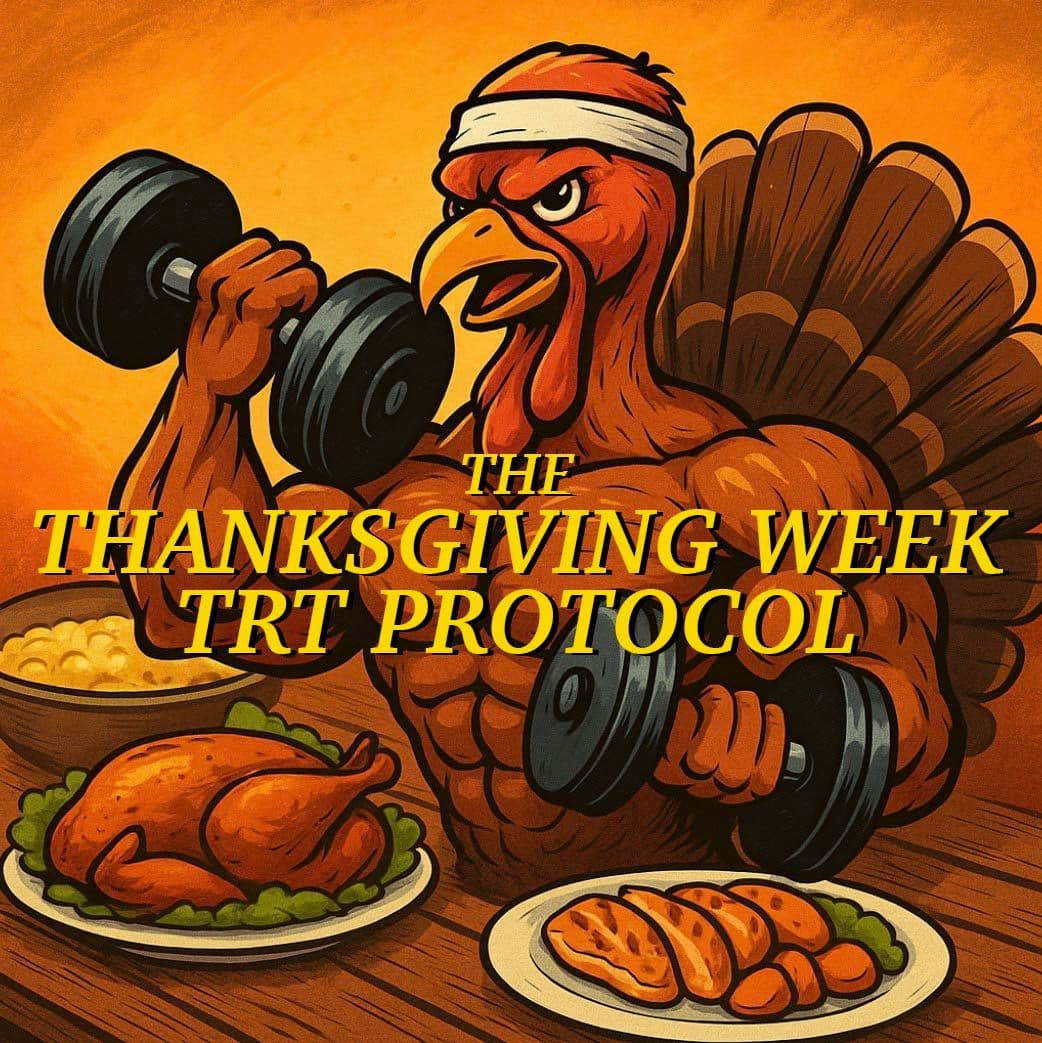
You've been dialing in your testosterone replacement therapy for months. Your energy is up, recovery is solid, and you're finally seeing real progress in the gym. Then Thanksgiving rolls around, and suddenly you're staring down a week of family dinners, multiple desserts, and your uncle's famous cocktails. Should you adjust your protocol? Skip injections? Fast beforehand to "save room"?
Here's the truth: you're overthinking it.
One Week Won't Crater Your Progress
Let's get the anxiety out of the way first. Your TRT protocol isn't as fragile as you think. Testosterone cypionate or enanthate has a half-life of about 8 days, meaning stable levels don't collapse because you ate three pieces of pie on Thursday. Your body isn't a light switch that flips off the moment you deviate from your usual routine.
The guys who struggle during holiday weeks aren't the ones who enjoy Thanksgiving dinner. They're the ones who use the holiday as an excuse to abandon everything for seven straight days, then panic and overcorrect. You're not going to do that, because you understand the difference between a celebratory meal and a week-long binge.
Keep Your Injection Schedule Normal
This might seem obvious, but it's worth stating clearly: don't skip or reschedule your injections to "accommodate" the holiday. If you pin Monday and Thursday, stick with Monday and Thursday. If you're on a daily protocol, keep it daily.
Some guys convince themselves that moving their injection schedule around for travel or family time is no big deal. But here's what actually happens - you create unnecessary fluctuations in your levels, which can affect how you feel. That brain fog you're blaming on turkey? Might actually be from randomly deciding to skip your Wednesday injection and push it to Saturday.
Traveling for the holiday? Pack your supplies. Going to your in-laws? Take 30 seconds in the bathroom. This isn't complicated, and you don't need anyone's permission to maintain your health protocol.
The Training Window Isn't Closing
You'll see plenty of advice telling you to crush a heavy leg day before Thanksgiving to "earn your meal" or some variation of that thinking. Ignore it. Your relationship with food shouldn't require punishment or permission.
That said, if your normal training schedule falls during Thanksgiving week, keep it as normal as possible. Lifting maintains insulin sensitivity, helps partition nutrients, and honestly, you'll feel better mentally if you stick to your routine. But if you need to shift your Wednesday session to Tuesday or Friday because of travel, the world won't end.
What you shouldn't do is try to go extra hard to "make up" for holiday eating. Training yourself into the ground while stressed, sleep-deprived from travel, and eating differently than usual is how you get injured or sick. Your body is already managing more variables than normal. Don't add unnecessary stress.
Alcohol Deserves a Real Conversation
Here's where things get nuanced. Alcohol affects TRT users the same way it affects everyone else, just with a few extra considerations. It temporarily suppresses testosterone production (which matters less when you're on exogenous testosterone), impacts sleep quality (which matters a lot), stresses the liver (which is already processing your medication), and can increase estrogen conversion.
Does this mean you can't have a drink during Thanksgiving? Of course not. But the guy downing six beers on Wednesday, four glasses of wine Thursday, and whiskey all weekend is going to feel like garbage, TRT or not.
If you're going to drink, be strategic. Pick your moments. Maybe it's a couple glasses of wine with dinner, or one really good cocktail you actually enjoy. Stay hydrated between drinks. And maybe skip the nightcap - alcohol's worst effects on sleep and recovery happen when you drink close to bedtime.
Eat Like a Normal Human Having Thanksgiving
You don't need a special TRT Thanksgiving nutrition protocol. You're on testosterone replacement therapy, not chemotherapy. Your body can handle a big meal.
The biggest mistake guys make is trying to "save calories" by barely eating Wednesday or Friday. Then they show up starving to Thanksgiving dinner and eat until they're uncomfortable, feel awful, and spend the rest of the week in a restrict-binge cycle. That's not a TRT problem. That's a relationship-with-food problem.
Here's a better approach: eat normally leading up to Thursday. Have a regular breakfast Thanksgiving morning so you're not ravenous. Enjoy your meal without treating it like a competitive eating challenge. Take seconds if you want them. Have pie. Then go back to eating normally Friday.
Your body is extremely good at handling occasional large meals. Testosterone actually helps with nutrient partitioning, meaning your muscle tissue is more likely to grab incoming nutrients than if you had low T. One day of eating more isn't going to suddenly make you fat or kill your progress.
Sleep Matters More Than You Think
This is where holiday weeks actually can derail things. Late nights, early mornings with traveling, different beds, family stress, alcohol - all of this chips away at sleep quality. And poor sleep tanks your recovery, affects your mood, increases cortisol, and can even impact how well your body utilizes testosterone.
You can't control everything, but you can control some things. Try to keep your sleep schedule as consistent as possible. If you're staying with family, bring earplugs and a sleep mask. Skip that third cup of coffee after dinner. Put your phone down an hour before bed instead of doom-scrolling news or arguing with strangers online.
The guys who feel terrible the week after Thanksgiving usually aren't wrecked from the food. They're wrecked from five nights of bad sleep combined with travel stress and disrupted routines.
Getting Back to Baseline
Friday morning, you wake up feeling heavier and a bit sluggish. Completely normal. Your body is holding extra water from the higher carb and sodium intake. You didn't gain five pounds of fat overnight - you're just carrying more glycogen and water.
Don't panic and don't overcorrect. Go back to your normal eating routine. Hit your regular training schedule. Stay hydrated. Within a few days, you'll be right back to where you were.
This is actually where being on TRT helps. Your testosterone levels are stable, which means your body composition, energy, and recovery capacity bounce back faster than if you had low T. You're not fighting an uphill battle against crashed hormones.
Perspective Over Perfection
Your TRT protocol exists to improve your quality of life, not to make you anxious about living it. Thanksgiving is one week. If you maintain your injection schedule, train normally when you can, don't go crazy with alcohol, sleep as well as possible, and eat like a reasonable adult, you'll be fine.
The guys who see the best long-term results with TRT aren't the ones who never deviate from their plan. They're the ones who understand that sustainable protocols have room for real life. They know that consistency matters more than perfection, and that one holiday week doesn't define their health trajectory.
If you're working with a provider who actually understands hormone optimization - like the team at AlphaMD - this is exactly the kind of perspective they'll reinforce. Good TRT management isn't about rigid rules. It's about building a protocol that works with your life, not against it.
So this Thanksgiving, stop worrying about whether the cranberry sauce will tank your testosterone. Enjoy your meal, stick to your protocol basics, and get back to your routine Friday. Your progress will be waiting for you.
Have a question? Ask us.
At AlphaMD, we're here to help. Feel free to ask us any question you would like about TRT, medical weightloss, ED, or other topics related to men's health. Or take a moment to browse through our past questions.
People are asking...
Is there one diet that’s best or optimal for TRT? I usually eat following the Mediterranean diet. Frankly I never even thought about this until I just...
Mediterranean diet. That's a good diet to be on. It does depend on your goals. In general as long as you're eating healthy, regularly, and getting food fats in that's the mort important. It's more abo... See Full Answer
Does anyone "time" TRT use according to their endurance schedule? That is, I *know* roughly when I'm going to bottom out -- during the two hardest mon...
From personal experience, I have raised my Testosterone consumption during periods I know it was dropping due to reasons like the above. However, I am already on a baseline of TRT, so I don't really r... See Full Answer
Do you have any theories as to why some people experience a honeymoon phase for a few weeks then lose the benefits of TRT?...
The most common reason for this in men tends to be a need for a simple dose adjustment. There's a general 8 week uptake period where injected levels increase week over week & then natural production ... See Full Answer
Get $30 off your first month’s order
Enter your email address now to receive $30 off your first month’s cost, other discounts, and additional information about TRT.
Legal Disclaimer
This website is a repository of publicly available information and is not intended to form a physician-patient relationship with any individual. The content of this website is for informational purposes only. The information presented on this website is not intended to take the place of your personal physician's advice and is not intended to diagnose, treat, cure, or prevent any disease. Discuss this information with your own physician or healthcare provider to determine what is right for you. All information is intended for your general knowledge only and is not a substitute for medical advice or treatment for specific medical conditions. The information contained herein is presented in summary form only and intended to provide broad consumer understanding and knowledge. The information should not be considered complete and should not be used in place of a visit, phone or telemedicine call, consultation or advice of your physician or other healthcare provider. Only a qualified physician in your state can determine if you qualify for and should undertake treatment.